
Eric McDowall and Gordon Cooper have provided additional information on the restoration of the upper part of Welshpool town Lock…
I attended the ‘Welshpool Big-Dig’ on the 18-19 October 1969 when around two-hundred of us slept in the Ballroom which was on the first floor of the disused Welshpool Railway Station. The amount of canal we cleared of trees growing out of the bed and other vegetation and mud that weekend was amazing. By the end of the Saturday, we were all pretty knackered, but satisfied with our efforts. I remember working in a small party of volunteers alongside the Hy-Mac long arm excavator.
By 1972, I was working for Canal Transport Services (CTS) at Norton Canes steering their trip boat ‘David’ (ex- GUCCCo ‘Aldebaran’) and based at Brewood on the Shroppie. One day, Graham Palmer of London WRG came to see me at Brewood. Would I look after a band of local volunteers at Welshpool, to restore the upper end of the Town Lock? It was a commitment to be able to attend at Welshpool for quite a few weekends and oversee the work there.
Earlier in the sixties, British Waterways (BW) had removed the top-end, almost semi-circular cast-iron lock gates from Welshpool lock and the wing walls, the stone cill, the unique horizontal ground paddle, its frame, the sliding mechanism and ‘paddle post’ and carted it all off to Stoke Bruerne to be part of the museum there. They had “sort of” bricked up a part of the damage done at Welshpool and filled the remainder with an earth dam. This is how it was when the Big-Dig happened in 1969.
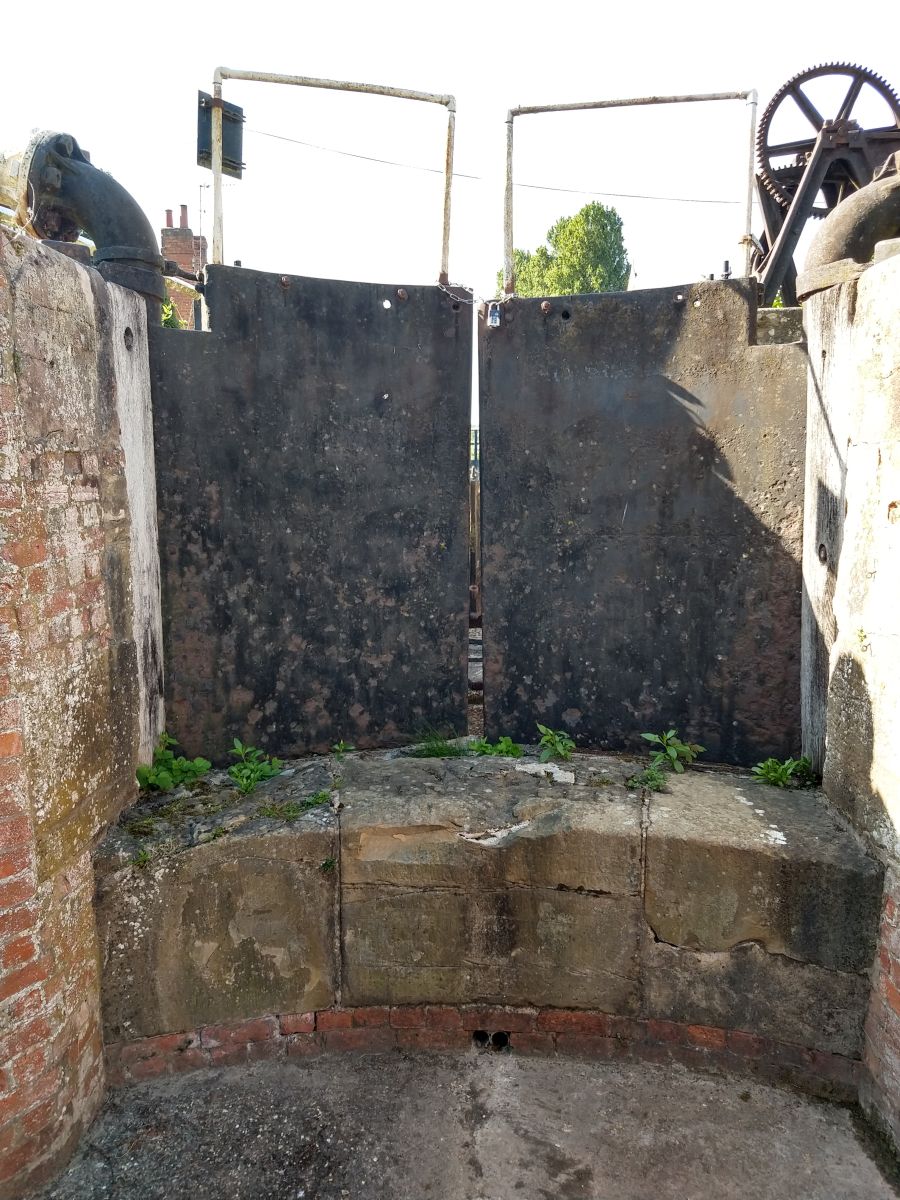


I said yes to Graham. My next involvement was being asked to attend a meeting at the Royal Oak Hotel in Welshpool in perhaps April 1972. I attended with Graham Palmer, Jim Evans, Harry Machin, Edgar Davidson the BW Section Inspector from Ellesmere yard and perhaps others I have forgotten. Jim presented a detailed drawing of the steel re-enforced concrete walls for the fore bay, sides, gate recess, invert floor and cill. The vertical walls were to be around 9 inches thick using shuttering plywood and suitable bracing timbers with shuttering front and behind. There were to be moulds for casting concrete coping stones. The brickwork that BW had put in after removal of the stonework was also to be demolished. There were suppliers arranged who would deliver the plywood, the re-enforcing bar, wire to tie the steel bars together, and a supply of ready-mixed concrete when we were ready for it.
Edgar Davidson asked what we were going to do about a lock gate? I don’t think there was any idea of the answer at that time. He said he may be able to help – he had a “spare” top-end lock gate! We had to ask how it was he had a spare? He had been responsible for a stoppage on the Trent and Mersey (T&M) Canal (somewhere) and two gates arrived from two different BW gate making yards for this stoppage. One gate was of steel with timber sealing pieces bottom and sides; the other gate was all oak. They fitted the steel gate at that stoppage, and he hid the oak gate at Ellesmere yard behind a shed. It had laid there for some while. This would change a number of things I thought: we would have to make the concrete walls, cill etc. to match an existing gate.
I think that the first work-party weekend was fixed and the demolition work started. I asked Gordon Cooper if he would go to Ellesmere and make a detailed drawing of the lock gate and report back. When he did, Gordon’s drawing raised some eyebrows.
The gate was symmetrical about its centre line, but was some six inches wider at the top than it was at the bottom. The joints in the quoin post and clapper end dictated how the balance beam would be fixed. It wasn’t ideal in the sense that, to me, the balance beam should be towpath side. It also did not have a paddle board. I decided that we needed to go and measure some T&M top gates and planned a trip to Stone to try and take measurements.
On site, we uncovered the broken remains of the cast iron culvert that turned towards the chamber, under the cill, from the removal of the horizontal paddle frame etc., to Stoke Bruerne. It was decided we needed to fill this iron culvert with concrete. There was no provision in Jim’s plan for a ground paddle and constructing one was probably beyond the scope of us at that time. The canal was still under threat of being filled in. Could Gordon make a paddle hole in the gate at Ellesmere?
Measuring as best we could at Stone, it was clear that all Brindley’s T&M top gates were wider at the top than the bottom. Not only did that ‘kind-of’ match the batter of the side walls, but also these gates were inclined towards the lock. The top of the closed gate was not vertically above its bottom. A plumb line showed that the inclination was about half of the width difference. On the River Trent towpath, I had seen gates that horses apparently could push open, but self closed. This was done by having inclined hinges. In the pub at Welshpool, we made models using beer-mats: if your gate is wider at the top and is inclined towards the lock, then its centre of gravity rises as it is opened – to half way – then it falls into the gate recess. On closing, it rises out of the recess to half way, then falls until it reaches the cill. It will stay open or shut, but not half-way. Clever!
Over a few weekends, we completed removal of the old and broken invert and cill having made some progress into the side walls. There was brick layer after brick layer in the side walls. In the end. I called a halt in the brick removal process. We were already deep enough in to make Jim’s concrete walls, we just would struggle to get a back shutter in place. I decided that if we cleaned the brick surface, we could bond the concrete on to the brickwork. I think re-bar was laid for the invert, and the invert floor was poured. We had to set a cast iron “cup” into the wet concrete in just the right position for the pin in the bottom of the oak quoin.

Gordon made progress with the gate at Ellesmere. Yes, he could make a paddle hole.
On site, we cast coping stones every weekend. We cast the hollow quoin. Three large lumps of timber were delivered: the cill seal and the two ‘verticals’ for the quoin and clapper sides. The angles were checked and double checked. The side timbers had to match the widths of the gate and incline 3 inches towards the chamber at the top, just like the T&M gates we had measured. We had put large threaded bolts in the concrete for securing the timber work, and had to bore the holes in the timber to align with our bolts.
The side wall re-bar was tied in place with the wire and then the front shuttering fixed and supported with props so it could not move while the concrete was wet. With no back shutter, the amount of concrete that was poured in the side walls far exceeded Jim’s calculations. The ready-mix company seemed to cope OK. All poured concrete was vibrated to remove any voids or bubbles.
We had a standing joke, often repeated after a few beers: if at some point in the far distant future, somebody decided to put the top-end of Welshpool Town Lock into a museum, they just had to fix four lifting eyes, then lift the whole thing out in one piece, gate and all. We thought our construction would survive the atomic armageddon.
We were doing fine with the job. I had a personal job offer from Threefellows Carrying that I didn’t want to turn down. I was going to have to leave CTS and Brewood, the Shroppie, and move to Sawley. I hadn’t actually seen the gate at Ellesmere yard. Everything we’d done was by Gordon’s drawing of the gate and Jim’s concreting plan. For a while, my involvement with the Montgomery was suspended!
I was very pleased to be invited to attend at Welshpool on the 23rd May 1974 when Prince Charles came to declare the lock open. It was a great honour for me to shake the hand of our now King, the one and only time I have ever spoken with him.

Eric McDowall
I had become a member of the Shropshire Union Canal Society and my involvement began with the Welshpool Town Lock project.
The gate at Ellesmere yard required considerable modification. Our agreement with the British Waterways Board (BWB), such as it was, stipulated that the canal society did all the work, BWB would only advise. It could not happen today as it did then because of H&S legislation. I suspect this was only partially in place and a blind eye was turned. I hate to think of personal liability implications.
I did all the work myself; as I worked shifts and I had time off in midweek. BWB turned the lock gate over at Ellesmere Yard, when I required this, with a wooden armed crane. It was a very different world 60 years ago!
Two vertical mullions of oak had to be fitted to support the iron paddle frame. I fastened the frame to the gate. I believe this and all other ironwork used on the gate were supplied by BWB locally, as were the standard Elm paddle boards.
All was then transported to the lock side. We lifted the gate into place, but that’s another story. I did the final-fit of the gate without any BWB assistance as I did for many other gates on the Monty.


Gordon Cooper